
That is why, before hosting a large-scale event, we need to clarify the following points precisely:
- who works in which role and in which area,
- what information you need to know about the programme, the venue and admission,
- What do we say, for example, in the event of a delay, a change of room or a problem with access,
- which situations can the hostess resolve on her own, and when should a supervisor or the organiser be involved,
- how the handover and transfer of information take place when someone goes on a break or moves to a different post.
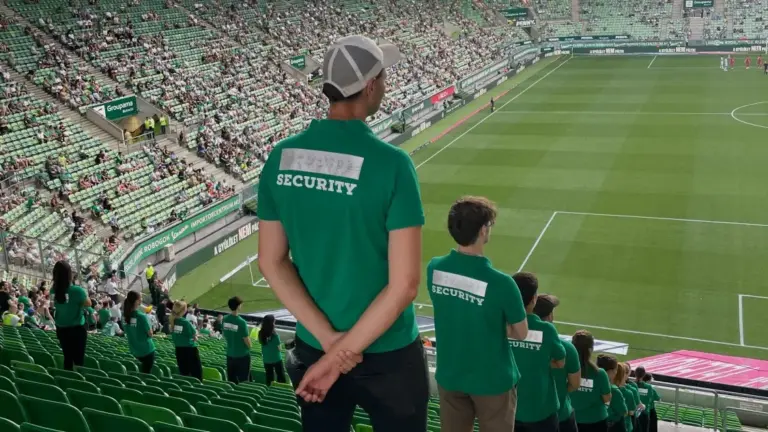
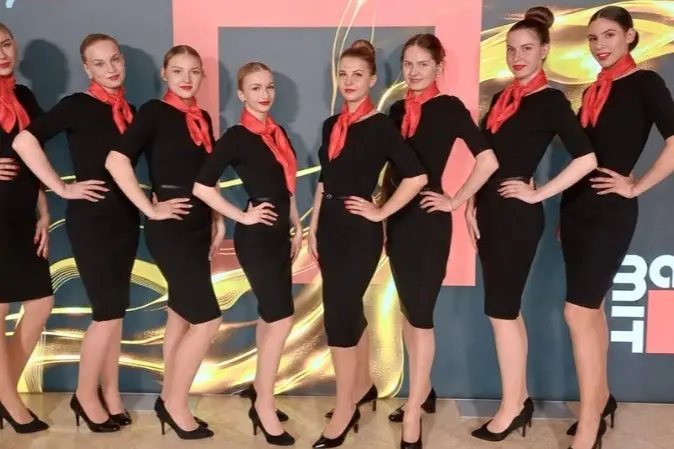
However, this alone is not enough. A uniform appearance is just as important: a uniform is not merely a matter of aesthetics, but also helps guests at an event attended by hundreds or thousands of people to immediately recognise who they can turn to for help.
Guests should feel that, whoever they turn to, they will receive prompt and accurate assistance.
In practice, this really becomes apparent when dozens of hostesses and hosts are working at the same time, in different roles, yet as a single, cohesive team. Here are a few examples from recent times:
- FTC v Real Madrid, Groupama Arena – A team of 136 people
- Semmelweis End-of-Year Show, MVM Dome – A team of 50 people
- Pitbull concert, Puskás Arena – A team of 40 people
Because a large number of people alone does not necessarily mean a well-functioning team. It is coordination that makes the difference.